
SEO and SEM in Digital Marketing: What’s the Difference?
Search engines are often where a customer’s journey begins. Whether someone is researching a product, comparing services or looking for a nearby business, appearing in relevant search results can help a brand reach them at the right moment. Two common ways to do this are search engine optimisation (SEO) and search engine marketing (SEM).
Although the terms are sometimes used interchangeably, SEO and SEM involve different approaches. Understanding how they work—and how they can complement one another—can help businesses build a more effective digital marketing strategy.
What is SEO?
SEO is the process of improving a website so it is more likely to appear prominently in unpaid, or organic, search results. It involves making a site useful to visitors and easier for search engines to understand.
SEO typically includes several areas:
- On-page SEO: Improving page content, headings, titles, internal links and other elements on the website.
- Technical SEO: Helping search engines crawl and index the site, while improving factors such as page speed, mobile usability and site structure.
- Off-page SEO: Building the website’s reputation through relevant links and mentions from other credible websites.
- Content: Creating useful, accurate information that addresses the questions and needs of the intended audience.
- Local SEO: Helping a business appear in location-based searches, such as searches for nearby services.
SEO is a long-term activity. Results can take time, and rankings are influenced by competition, search engine updates and the quality of a website’s content and experience. However, strong organic visibility can attract relevant visitors without paying for every click.
What is SEM?
Search engine marketing, or SEM, commonly refers to paid advertising on search engines. Businesses bid to show adverts for selected search terms, often through platforms such as Google Ads or Microsoft Advertising. Depending on the platform and campaign settings, adverts may appear above or alongside organic search results.
With paid search, advertisers can choose keywords, set budgets, write advert copy and direct users to specific landing pages. They may pay when someone clicks an advert, although the precise model and costs depend on the campaign.
Paid campaigns can begin generating visibility quickly, making them useful for promoting a new offer, reaching a particular audience or testing demand. Their reach is generally tied to the campaign budget: when advertising stops, the paid visibility usually stops too.
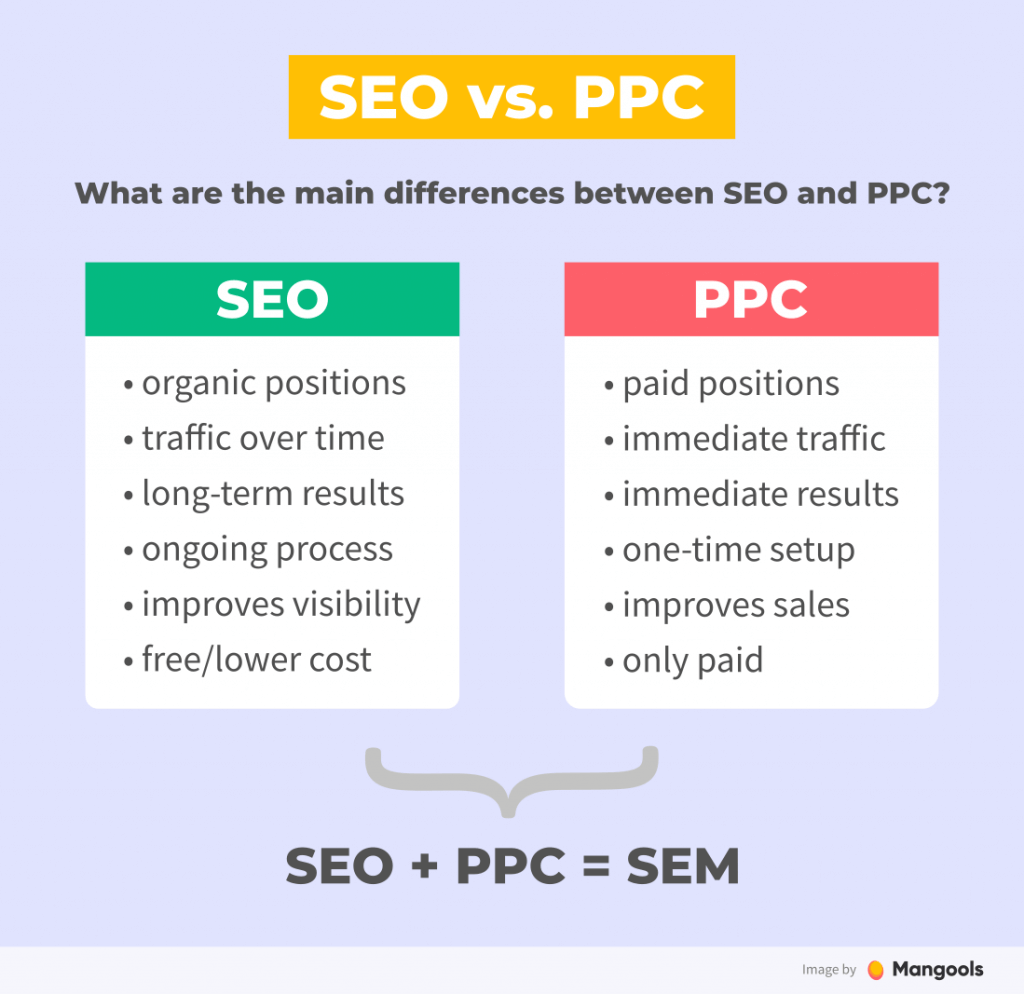
SEO vs SEM: the key differences
| SEO | Paid search (often called SEM) |
|---|---|
| Focuses on organic search visibility | Uses paid adverts in search results |
| Usually takes time to build | Can deliver visibility soon after a campaign launches |
| Does not charge for each organic click | Often charges advertisers when users click |
| Can continue attracting visits after work is completed, although ongoing maintenance is important | Visibility usually depends on the campaign remaining active and funded |
| Relies on useful content, site quality and authority | Relies on budget, targeting, advert quality and landing-page relevance |
Terminology can vary. Some marketers use SEM as a broad term for marketing through search engines, including both SEO and paid search. Others use it specifically to mean paid search advertising. It is helpful to define what is meant when planning or discussing a campaign.
How SEO and SEM work together
SEO and paid search do not have to compete for budget or attention. Used together, they can provide a more complete presence in search results.
- Cover different timeframes: Paid search can support immediate campaigns, while SEO builds visibility over time.
- Test search terms: Paid campaigns can provide quick insight into which keywords attract relevant visitors. These findings can inform SEO content planning.
- Reach more searchers: Appearing in both paid and organic results can increase a brand’s visibility for valuable searches.
- Support seasonal activity: Advertising budgets can be adjusted for short-term promotions, while useful evergreen content continues to serve customers throughout the year.
- Improve landing pages: Insights from both channels can show which messages and pages are most relevant to prospective customers.
Choosing the right approach
The right balance depends on a business’s goals, competition, budget and timescales. SEO may be a priority for organisations seeking sustainable organic traffic and willing to invest in content and website improvements. Paid search may be more suitable when quick exposure, precise campaign control or immediate lead generation is important.
Before investing, define the desired outcome. This could be online sales, enquiries, bookings, newsletter sign-ups or visits to a physical location. Then identify the audience, research relevant search terms and make sure the website offers a clear, useful next step.
Measuring performance
Measure SEO and paid search against business outcomes, not just visibility. Useful metrics may include:
- Organic and paid visits from search
- Clicks and click-through rate
- Leads, sales or other conversions
- Cost per click and cost per conversion for paid campaigns
- Revenue and return on advertising spend, where relevant
- Search rankings and the quality of traffic reaching the site
Analytics should be interpreted in context. A high number of visits is not necessarily valuable if those visitors are unlikely to take the desired action. Tracking should also respect applicable privacy and data protection requirements.
Building a balanced search strategy
SEO and SEM are valuable parts of digital marketing, but neither can compensate for an unhelpful website or an unclear offer. The strongest search strategies combine relevant content, a technically sound website, well-targeted advertising and a straightforward user experience.
By understanding the differences between organic optimisation and paid search, businesses can set realistic expectations, allocate resources more effectively and make it easier for potential customers to find them.
Understanding SEO and SEM: Key Questions and Answers in Digital Marketing
- What is SEO in digital marketing?
- What is SEO and SMM in digital marketing?
- What is SEO and SEM in marketing?
- What is SEM in digital marketing?
- Is SEO or SEM better?
- What is difference between SEM and SEO?
- What is the difference between paid SEO and SEM?
- Do you need both SEO and SEM?
What is SEO in digital marketing?
SEO, or search engine optimisation, is the process of improving a website so it is more likely to appear in relevant, unpaid search results. In digital marketing, this involves creating useful content, researching the terms people search for and making sure a website is easy for both visitors and search engines to use. SEO can help attract qualified traffic over time, although results are not immediate and depend on factors such as competition, content quality and technical performance.
What is SEO and SMM in digital marketing?
SEO (search engine optimisation) helps a website appear more prominently in unpaid search engine results by improving its content, technical performance and authority. SMM (social media marketing) uses social platforms to build awareness, engage audiences and promote products or services through organic posts and paid adverts. Both can support digital marketing goals, but SEO focuses on visibility in search engines, while SMM focuses on reaching people through social media.
What is SEO and SEM in marketing?
SEO (search engine optimisation) is the process of improving a website so it can appear more prominently in unpaid search results, using relevant content, technical improvements and reputable links. SEM (search engine marketing) is often used to describe paid search advertising, where businesses pay to show adverts to people searching for selected terms. Together, SEO and SEM help businesses increase their visibility in search engines: SEO builds organic presence over time, while paid search can deliver targeted exposure more quickly.
What is SEM in digital marketing?
SEM (search engine marketing) is the use of search engines to promote a business and attract visitors to its website. The term is often used to mean paid search advertising, where businesses pay to display adverts in search results for selected keywords. Advertisers can set budgets, target particular audiences and measure clicks or conversions. Some people use SEM more broadly to include SEO as well, so it’s worth checking how the term is being used.
Is SEO or SEM better?
Neither SEO nor SEM is better in every situation; the right choice depends on your goals, budget and timescale. SEO can build lasting organic visibility, but it usually takes time to show results. SEM, often referring to paid search advertising, can bring quicker visibility and more campaign control, but requires ongoing spend. Many businesses use both: SEM for short-term campaigns and testing keywords, and SEO for sustainable growth over time.
What is difference between SEM and SEO?
SEO (search engine optimisation) improves a website’s visibility in unpaid, organic search results through activities such as creating useful content and improving site performance. SEM (search engine marketing) is often used to describe paid search advertising, where businesses pay to display adverts for selected search terms. SEO generally takes longer to build but can deliver ongoing organic traffic, while paid SEM can provide quicker visibility for as long as the campaign is funded. The terms are sometimes used differently, so it is worth checking whether SEM refers specifically to paid search or to search marketing more broadly.
What is the difference between paid SEO and SEM?
“Paid SEO” is not a standard term: SEO (search engine optimisation) usually means improving a website’s visibility in unpaid, organic search results. SEM (search engine marketing) is sometimes used broadly for search marketing, but often refers specifically to paid search adverts, such as pay-per-click campaigns. In short, businesses typically invest in SEO to build organic visibility over time, while paid search provides visibility through adverts for as long as the campaign is running.
Do you need both SEO and SEM?
You don’t always need both SEO and SEM, but using them together can create a stronger search strategy. SEO helps build long-term visibility in organic results, while paid search (often called SEM) can deliver quicker exposure and support time-sensitive campaigns. The right balance depends on your goals, budget and timescale: a business may begin with one approach, then add the other as its needs grow.
- digital agency
- digital marketing
- digital marketing agency
- digital marketing companies
- digital marketing company
- digital marketing seo
- digital seo
- digital strategy
- engine
- engine digital
- engineering
- marketing
- marketing agency
- marketing companies
- search engine marketing
- search marketing
- sem
- sem company
- sem search engine marketing
- sem services
- seo
- seo agencies
- seo agency
- seo companies
- seo company
- seo services
- service marketing
- strategy digital