
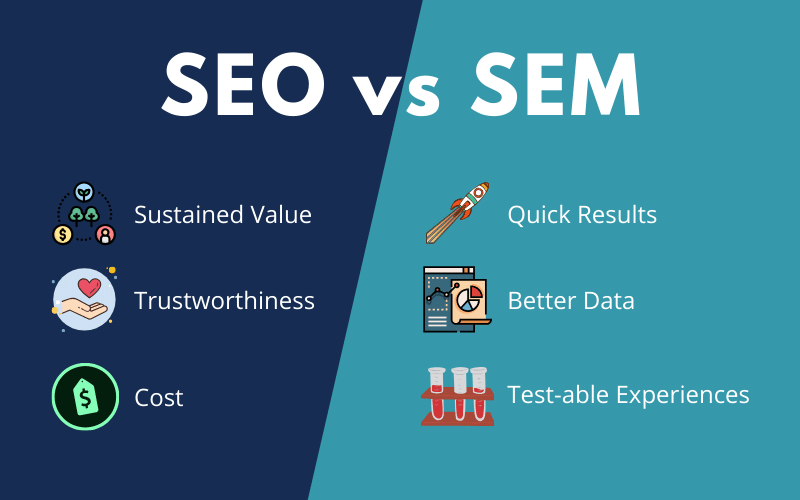
SEO and SEM: How Search Marketing Can Grow Your Business
When people need a product, service or answer, they often start with a search engine. Search engine optimisation (SEO) and search engine marketing (SEM) help businesses reach those people at the right moment. Used together, they can increase visibility, attract relevant visitors and support long-term business growth.
What is SEO?
SEO is the process of improving a website so that it is more likely to appear prominently in unpaid, or organic, search results. It combines useful content, technical improvements and signals that help search engines understand a site and assess its relevance.
Common SEO activities include:
- Keyword research: finding the words and questions people use when searching for relevant information, products or services.
- Content optimisation: creating clear, helpful pages that answer those searches and use relevant terms naturally.
- Technical SEO: improving factors such as page speed, mobile usability, site structure and crawlability.
- On-page optimisation: refining page titles, headings, links and descriptions to make pages easier to understand.
- Reputation and authority: earning credible mentions and links from other relevant websites.
SEO is a long-term investment. Results can take time, but well-maintained organic visibility can continue to attract visitors without paying for every click.
What is SEM?
SEM stands for search engine marketing. The term is sometimes used broadly to describe marketing through search engines, including both SEO and paid search. It is also commonly used to refer specifically to paid search advertising, such as pay-per-click (PPC) campaigns. Because usage varies, it is useful to clarify what is meant when planning a campaign.
With paid search, businesses bid to show adverts for selected search queries. Advertisers typically pay when someone clicks an advert, although campaign costs and billing arrangements depend on the platform and format. Paid campaigns can provide visibility quickly and allow advertisers to target audiences by factors such as location, search terms and device.
SEO and paid search: key differences
- Speed: paid search can generate visibility soon after a campaign launches, while SEO usually takes longer to build.
- Cost: paid search requires an advertising budget, and costs may accrue for each click. SEO involves investment in expertise, content and site improvements, but organic clicks are not purchased individually.
- Longevity: paid visibility generally stops when a campaign ends. Strong organic rankings may continue to bring traffic, although they need ongoing attention.
- Control: paid campaigns offer direct control over budgets, targeting and advert copy. Organic visibility is influenced by search engine systems and competitors as well as a website’s quality.
Why combine SEO and SEM?
SEO and paid search can support different goals, making them valuable parts of the same digital marketing strategy. Paid campaigns can help promote a time-sensitive offer or test which messages attract clicks. SEO can build lasting visibility for useful content and important service pages.
Search data can inform both approaches. For example, paid search results may highlight valuable search terms, while SEO research can uncover questions and topics worth developing into content. Coordinating landing pages, messaging and measurement can also create a more consistent experience for potential customers.
Building an effective search marketing strategy
- Set clear objectives. Decide whether the priority is brand awareness, enquiries, sales, bookings or another measurable outcome.
- Understand your audience. Research what people are looking for and the language they use at different stages of their decision-making.
- Build useful landing pages. Ensure each page is relevant to its search terms, easy to navigate and clear about what visitors can do next.
- Choose the right channel mix. Use SEO for sustainable organic growth and paid search where speed, precise targeting or campaign control is important.
- Track meaningful results. Monitor metrics such as qualified traffic, conversions, cost per acquisition and revenue—not just rankings or clicks.
- Test and improve. Review campaign and website performance regularly, then refine keywords, content, adverts and landing pages.
Common mistakes to avoid
Search marketing is less effective when it focuses on rankings or traffic without considering relevance and business outcomes. Avoid targeting broad keywords that do not match your offer, sending advert clicks to generic pages, or publishing content simply to include search terms. Technical problems, slow-loading pages and unclear calls to action can also undermine otherwise strong campaigns.
It is equally important to set realistic expectations. SEO is not an instant fix, and paid search does not guarantee profitable results. Performance depends on factors such as competition, budget, website quality, audience demand and the strength of the offer.
Make search work as part of your wider marketing
SEO and SEM are most effective when they support a clear business strategy. By understanding what your audience is searching for, providing genuinely useful pages and measuring outcomes carefully, you can make better use of both organic and paid search. The right balance will depend on your goals, resources and timescales—and should be reviewed as your business and search behaviour evolve.
9 Essential Tips for Effective SEO and SEM in Digital Marketing
- Research keywords before creating content.
- Write clear, useful page titles and meta descriptions.
- Make your website fast and mobile-friendly.
- Use descriptive headings and image alt text.
- Create helpful content for your target audience.
- Track organic traffic and rankings regularly.
- Set a clear goal for every paid search campaign.
- Test ad copy and landing pages to improve conversions.
- Review campaign data and adjust your budget accordingly.
Research keywords before creating content.
Research keywords before creating content to understand what your audience is searching for and how they phrase their questions. Use this insight to choose relevant topics, shape useful content and align each page with the right search intent. For SEO, this can help attract organic visitors; for paid search, it can guide keyword targeting and advert messaging. Focus on terms that are relevant to your business and audience, rather than simply choosing those with the highest search volumes.
Write clear, useful page titles and meta descriptions.
Write clear, useful page titles and meta descriptions to help people understand what each page offers before they visit. Keep titles concise and specific, and make sure they accurately reflect the page content. Use the meta description to summarise the main benefit or information and, where appropriate, include a simple call to action. Relevant, compelling wording can encourage more people to click your result in search listings, while misleading descriptions may disappoint visitors and undermine trust.
Make your website fast and mobile-friendly.
Make sure your website loads quickly and works smoothly on mobile devices. Visitors are more likely to leave if pages are slow, difficult to read or awkward to navigate on a phone, which can reduce enquiries and sales. Use responsive design, compress images and remove unnecessary elements to improve performance. A fast, mobile-friendly site also makes it easier for search engines to crawl and understand your pages, supporting both your SEO efforts and the results of paid search campaigns.
Use descriptive headings and image alt text.
Use clear, descriptive headings to organise your page and help readers quickly find the information they need. Headings also give search engines useful context about each section, so make them relevant and specific rather than relying on vague labels. Add concise, accurate alt text to images to describe their content for people using screen readers and when images cannot load. Together, well-structured headings and thoughtful alt text can improve accessibility, user experience and the clarity of your SEO content.
Create helpful content for your target audience.
Create helpful content that answers the questions your target audience is already asking. Research their needs, use clear language and provide practical, trustworthy information rather than writing simply to include keywords. Useful content can support SEO by encouraging relevant organic visits, while also giving paid search visitors a more relevant, informative landing page. Over time, this can build trust and help people take the next step with your business.
Track organic traffic and rankings regularly.
Track organic traffic and search rankings regularly to understand how your SEO efforts are performing. Use analytics and search tools to spot changes in visitor numbers, the search terms bringing people to your site, and the pages gaining or losing visibility. Look beyond rankings alone: check whether organic visitors are engaging with your content and completing valuable actions, such as making an enquiry or a purchase. Regular reviews help you identify opportunities, address drops early and make informed improvements to your digital marketing strategy.
Set a clear goal for every paid search campaign.
Set a clear goal for every paid search campaign before choosing keywords or setting a budget. Decide what success looks like—such as generating qualified enquiries, increasing online sales or encouraging bookings—and choose a measurable conversion to track. A specific objective helps you shape your adverts and landing pages, allocate your budget effectively and assess whether the campaign is delivering worthwhile results.
Test ad copy and landing pages to improve conversions.
Test different versions of your ad copy and landing pages to discover what encourages more people to take action. Experiment with headlines, calls to action, page layouts and offers, changing one element at a time where possible. Then compare results using meaningful measures, such as enquiries, sales or conversion rate—not clicks alone. Regular testing can help you refine your message, make the landing page more relevant to the search, and get better value from your digital marketing budget.
Review campaign data and adjust your budget accordingly.
Reviewing campaign data regularly helps you understand which keywords, adverts and channels are delivering the best results. Compare performance against your goals, looking beyond clicks to metrics such as conversions and cost per acquisition. You can then shift budget towards the campaigns that are generating valuable outcomes, while reducing or refining spend where performance is weaker. Make changes thoughtfully and continue monitoring results, as the most effective budget allocation may change over time.
- digital marketing
- digital marketing companies
- digital marketing company
- digital marketing seo
- digital seo
- digital strategy
- engine
- engine digital
- engineering
- marketing
- marketing companies
- search engine marketing
- search marketing
- sem
- sem company
- sem search engine marketing
- seo
- seo companies
- seo company
- seo marketing services
- seo services
- service marketing